Talk to a Home Loan Specialist
Do you have questions about getting a mortgage? Our experienced lending team of U.S. Military Veterans can guide you through each step. From pre-approval to closing, we'll help you meet your homebuying goals.
GET STARTED TODAYVA Loans
What is a VA home loan?
A VA home loan is a mortgage loan backed by the U.S. Department of Veterans Affairs (VA). Its primary purpose is to help Veterans, Servicemembers, and eligible surviving spouses become homeowners. As a core part of the VA's mission, they offer a home loan guarantee benefit along with other housing-related programs. While VA Home Loans are issued by private lenders like banks and mortgage companies, the VA guarantees a portion of the loan.
Benefits of Choosing a VA Home Loan
A VA (Veterans Affairs) home loan is a mortgage loan available to eligible veterans, active-duty personnel, and certain members of the National Guard and Reserves. The VA loan program was established to help veterans and their families achieve homeownership. Here are some of the primary benefits of choosing a VA home loan:
- No Down Payment Required: One of the most significant advantages of a VA home loan is the ability to finance 100% of a home's purchase price, meaning no down payment is necessary in most cases.
- No Private Mortgage Insurance (PMI): Conventional and FHA loans often require PMI if the down payment is less than 20%. With a VA home loan, there's no PMI, which can save borrowers a significant amount of money each month.
- Competitive Interest Rates: VA home loans tend to have lower interest rates than conventional loans because the VA guarantees a portion of the loan. This makes the loan less risky for lenders.
- Flexible Credit Requirements: VA home loans are often more accommodating when it comes to credit scores and history, allowing more veterans to qualify.
- No Prepayment Penalty: Borrowers can pay off their VA home loan earlier than the agreed-upon term without facing prepayment penalties.
Are You Eligible?
To be eligible for a VA home loan, you or your spouse must meet the below-stated requirements:
-
Service Eligibility: The primary requirement for VA home loan eligibility is service in the U.S. armed forces. This includes:
- Veterans who have served 90 consecutive days of active service during wartime, or
- 181 days of active service during peacetime, or
- 6 years of service in the National Guard or Reserves, or
- Some spouses of service members who have died in the line of duty or as a result of a service-related disability.
- Certificate of Eligibility (COE): To prove your eligibility for a VA home loan, you'll need a Certificate of Eligibility (COE), which can be applied for directly through the VA.
- Credit and Income Requirements: The VA doesn’t set a minimum credit score, but most lenders have their own criteria. Generally, a credit score of 620 or higher is favorable but credit scores from the 500's can also be acceptable. Borrowers also must show they have a reliable income that's sufficient to cover monthly expenses, including the new mortgage payment.
- Primary Residence Requirement: VA home loans are intended for primary residences, meaning you'll live in the home. They aren’t for vacation homes or investment properties.
-
VA Home Purchase Loan:
This is the most common type of VA home loan. It's used by veterans, active-duty service members, and eligible surviving spouses to purchase a primary residence without a down payment, provided the purchase price doesn't exceed the loan limit for the county. -
VA Interest Rate Reduction Refinance Loan (IRRRL):
Also known as the VA Streamline Refinance, the IRRRL allows those with a current VA home loan to refinance to a lower interest rate, often with reduced paperwork and underwriting requirements. It's important to note that an IRRRL can only be used to refinance a property that's already financed with a VA home loan. -
VA Cash-Out Refinance Loan:
This loan allows homeowners to refinance their non-VA or VA loan and take cash out of their home equity. It can be used to consolidate debt, make home improvements, or other financial needs. -
VA Native American Direct Loan (NADL) Program:
Specifically for Native American veterans or their eligible surviving spouses, this program provides loans to purchase, construct, or improve homes on Federal Trust Land or to refinance a prior NADL to reduce the interest rate. -
Purchase Loan & Cash-Out Refinance:
- Process: VA home loans are acquired through a lender of your choosing. The initial step is to get a Certificate of Eligibility (COE).
- Obtaining COE: You can secure a COE via your lender, through VA.gov, or by submitting a mail request.
-
Interest Rate Reduction Refinance Loan (IRRRL):
- COE Requirement: For IRRRL, a new COE is typically not needed. To demonstrate the previous utilization of your entitlement, you can either present your existing COE or your lender might opt for the e-mail confirmation procedure in place of the COE.
-
Native American Direct Loan (NADL) Program:
- Initial Step: Verify that your tribal organization is a participant in the VA direct loan program.
- Process: After confirmation, NADL loans are acquired via a lender of your choice. The prerequisite is obtaining a Certificate of Eligibility (COE).
- Obtaining COE: Secure a COE through VA.gov or by mail.
-
Adapted Housing Grants (SAH or SHA grant):
-
Application Process: For an SAH or SHA grant, you can begin your application by:
- Downloading and completing the VA Form 26-4555 (PDF). Once filled, submit it to the closest Regional Loan Center.
- Alternatively, you can also opt for the online application method.
-
Application Process: For an SAH or SHA grant, you can begin your application by:
Quick Loan Limit Overview
No Loan Limit for First-Time Users: For first-time VA home loan benefit users, there is no cap on how much they can borrow without a down payment. In other words, if they qualify, veterans can purchase a home without any down payment, regardless of the home's price. Buyers may purchase up to the VA loan limits per county.
Subsequent Use: For veterans or service members who have already used their VA home loan benefits and have their full entitlement restored, the no-limit rule also applies.
Partial Entitlement: For those who have used some of their entitlement and cannot have it fully restored, there will be a loan limit that may require a down payment. The amount of the loan limit will depend on the county's conforming loan limit and how much of their VA loan entitlement has been utilized.
Conforming Loan Limits: The VA typically references the Federal Housing Finance Agency's (FHFA) conforming loan limits to determine county-specific limits for those with partial entitlement. These limits can change yearly.
Down Payment for Loans Above the Limit: If a veteran chooses to buy a home that costs more than the county loan limit (and they don't have full entitlement), they might need to make a down payment. The required down payment will typically be 25% of the difference between the home's purchase price and the county's loan limit.
Types of VA Home Loans
Remember, while the VA backs these loans, they are actually offered by private lenders, like banks and mortgage companies. Therefore, interest rates, fees, and underwriting standards might vary by lender.
Simple Application Steps
Terms Explained
VA Home Loan: A mortgage loan in the U.S. backed by the U.S. Department of Veterans Affairs. Intended primarily for Veterans, Servicemembers, and eligible surviving spouses.
Certificate of Eligibility (COE): A document that proves you're eligible for a VA-backed loan. It's based on your service history and duty status.
Private Mortgage Insurance (PMI): Insurance that protects lenders from losses if a homeowner defaults on their mortgage. Not required for VA loans.
Interest Rate Reduction Refinance Loan (IRRRL): Commonly referred to as the VA Streamline Refinance, this is for homeowners with an existing VA home loan to refinance to a lower interest rate.
Native American Direct Loan (NADL) Program: This program provides loans to Native American veterans to buy, build, or improve homes on Federal Trust Land.
Adapted Housing Grants (SAH or SHA grant): Grants provided to veterans with certain severe service-connected disabilities to help buy or build an adapted home or modify an existing home.
Conforming Loan Limits: Limits set by the Federal Housing Finance Agency (FHFA) on the maximum amount for a mortgage. They can affect the loan limits for VA loans in certain situations.
Entitlement: Refers to the portion of a loan that the VA guarantees to a lender. It can be 'full' or 'partial' depending on how much of the VA loan benefit a borrower has used.
VA Purchase Loan: A loan used by eligible individuals to purchase a primary residence without needing a down payment, as long as the purchase price doesn't exceed the loan limit for the county.
VA Cash-Out Refinance Loan: Allows homeowners to refinance their non-VA or VA loan and convert their home equity into cash, which can be used for various purposes.
Primary Residence: The main place where an individual lives most of the time. VA loans are intended for financing primary residences.
FHA Loans
Affordable Home Financing: Making homeownership accessible and affordable for all.
What is an FHA loan?
An FHA loan, backed by the Federal Housing Administration, is designed to assist homebuyers with lower credit scores and minimal down payments. These loans come with prescribed limits, varying by region. Furthermore, the property being financed must meet specific safety, security, and structural integrity standards, necessitating an FHA-compliant appraisal.
We recognize the path to homeownership can be intricate. Our FHA landing page serves as a guiding light, equipping you with a comprehensive understanding of what an FHA loan entails through interactive tools, easy-to-grasp information, and on-demand assistance.
FHA Loan Requirements
FHA loans are insured by the Federal Housing Administration and are often more accessible. Here are typical requirements:
-
Credit Score:
- Minimum score usually 500-580.
- Borrowers with 500-579 typically need a 10% down payment.
- Borrowers with 580+ can often qualify for a 3.5% down payment.
-
Down Payment:
- Typically 3.5% for scores 580+.
- All down payment funds can come from gifts.
- Debt-to-Income Ratio (DTI): Can exceed 43% (up to 56.99%) depending on the lender and credit profile.
- Steady Employment History: 2 years of steady employment (can include college courses in your field).
- Property Requirements: Must be your primary residence and pass an FHA-approved appraisal for safety and soundness.
Key Benefits
- Lower Down Payment: As little as 3.5% down.
- Flexible Credit Requirements: More lenient credit score requirements than conventional loans.
- Competitive Interest Rates: Often come with competitive rates.
- Versatile Financing: Can be used for 1-4 unit properties, condos, or refinancing.
Loan Limits
The FHA establishes a cap on the loan amount they will insure. These limits are recalculated yearly. For 2023, the baseline for single-family homes was $472,030. The "FHA ceiling" (max amount) was $1,089,300 for high-cost areas.
2023 FHA Floor (Most Counties):
2023 FHA Ceiling (High-Cost Areas):
FHA Loan Types
- FHA 203(b) Fixed-Rate Loan: The most common type, for 1-4 unit primary residences.
- FHA Adjustable Rate Mortgage (ARM): Rate is fixed for an initial period (e.g., 5 or 7 years) then can adjust.
- FHA 203(k) Rehabilitation Loan: Allows you to purchase or refinance and include the cost of repairs.
- FHA Energy Efficient Mortgage (EEM): Provides funds for energy-saving improvements.
Mortgage Insurance
Mortgage insurance (MIP) is a significant component of FHA loans, compensating lenders for losses if you default. It includes:
-
Upfront Mortgage Insurance Premium (UFMIP):
- Typically 1.75% of the base loan amount.
- Can be paid at closing or rolled into the loan.
-
Annual Mortgage Insurance Premium (MIP):
- Varies based on loan term, LTV, and loan size.
2023 MIP Rates for FHA Loans Over 15 years:
2023 MIP Rates for FHA Loans Up to 15 years:
Application Process
- Determine Eligibility: Check credit, work history, etc.
- Select an FHA-Approved Lender: Find a lender experienced in FHA products.
- Pre-approval: Get an estimate of how much you might be approved for.
- Choose a Property: Find a home that will meet FHA appraisal standards.
- Complete the Loan Application: Provide proof of income, identity, assets, etc.
- Property Appraisal: The lender will order an FHA-approved appraisal.
- Underwriting Process: An underwriter reviews all documentation.
- Loan Approval: Receive a "clear to close."
- Closing: Sign all final paperwork and pay your down payment and closing costs.
USDA Loans
Specialized loans for rural homes with great benefits.
What is a USDA home loan?
A USDA home loan is a specialized mortgage program provided by the United States Department of Agriculture (USDA) to aid potential homeowners in acquiring properties in rural and semi-rural areas. The primary aim of this program is to foster growth and homeownership in areas that are less densely populated. One of the most significant advantages of USDA home loans is that they often require no down payment, making it easier for eligible individuals and families to own homes.
We recognize the path to homeownership can be intricate. Our USDA Loan landing page serves as a guiding light, equipping you with a comprehensive understanding of what a USDA home loan entails through interactive tools, easy-to-grasp information, and on-demand assistance.
Why Choose a USDA home Loan?
- No Down Payment Required: Finance 100% of the home’s price.
- Competitive Interest Rates: Typically offer lower interest rates than conventional mortgage loans.
- Flexible Credit Requirements: Often have more lenient credit requirements.
- Financing for Repairs: Some programs allow borrowers to include the costs of necessary home repairs.
- No Mortgage Insurance: USDA has a guarantee fee but no monthly mortgage insurance.
Type of USDA Home Loans
- USDA Guaranteed Loan: The most popular type. The USDA guarantees the loan, but funding comes from USDA-approved lenders. For low-to-moderate income homebuyers.
- USDA Direct Loan (Section 502): These loans come directly from the USDA for low and very low-income applicants. Interest rates can be as low as 1% with subsidies.
- USDA Home Improvement Loan & Grants (Section 504): Provides loans and grants for very low-income homeowners to repair or modernize their homes.
- USDA Rural Refinance Pilot Program: A refinance option for homeowners with existing USDA loans to secure a lower interest rate.
Are You Eligible?
To be eligible, you must meet these requirements:
- Income Limits: The USDA sets income limits based on the median income in your area.
- Property Location: The property must be in an area designated as rural by the USDA (many suburban areas qualify).
- Primary Residence: The property must be used as your primary residence.
- Credit Worthiness: Applicants generally must have a credit score of at least 640.
- Citizenship or Residency: Available to US citizens, non-citizen nationals, and Qualified Aliens.
- Dependable Income: Must demonstrate a stable income for at least 24 months.
Simple Application Steps
- Determine Eligibility: Check your desired property location on the USDA’s map and ensure you meet income requirements.
- Gather Documentation: Proof of identity, income, credit history, and assets.
- Find a USDA-Approved Lender: Research lenders in your area that offer USDA home loans.
- Complete the Application: Fill out the lender’s application form and submit your documents.
- Property Appraisal: The lender will arrange for a USDA-approved appraiser.
- Review and Approval: The lender will review your application and submit it to the USDA for final approval.
- Close on Your Loan: Sign all necessary paperwork to finalize the loan.
Terms Explained
USDA Home Loan: A mortgage program from the U.S. Department of Agriculture for properties in rural and semi-rural areas.
USDA-Approved Lender: A financial institution authorized to offer loans under the USDA program.
USDA Guaranteed Loan: A loan offered through an approved lender where the USDA guarantees the loan in case of default.
USDA Direct Loan: A loan that comes directly from the USDA, for low and very low-income applicants.
Disclaimer: The loan scenario is based on a 20-year fixed, property purchase price of $300,000, the loan amount is set at $280,000. The interest rate for this loan would be 5.750%, with an Annual Percentage Rate, or APR, of 7.146%. Your estimated monthly payment for this loan would be $1,965.28.Conventional Loans
What is a Conventional loan?
A conventional loan is a type of mortgage loan not insured or guaranteed by a government agency. These loans are backed by private lenders, and their terms and conditions are set by the lender. Conventional loans typically require a higher credit score and a larger down payment compared to government-backed loans, but they can have more flexible terms.
We recognize the path to homeownership can be intricate. Our Conventional Loan landing page serves as a guiding light, equipping you with a comprehensive understanding of what a Conventional loan entails through interactive tools, easy-to-grasp information, and on-demand assistance.
Benefits of Choosing a Conventional Loan
- No Private Mortgage Insurance (PMI) with 20% Down: If you put down 20% or more, you won’t have to pay PMI.
- Flexibility in Loan Terms: Typically range from 10 to 30 years.
- Higher Loan Limits: Often have higher loan limits than government-backed loans.
- Available for Various Property Types: Can be used for primary residences, second homes, and investment properties.
- Rate Choices: Borrowers can choose between fixed-rate and adjustable-rate (ARM) options.
Loan Types
Fixed-rate Mortgages (FRM)
Fixed-rate mortgages ensure that the interest rate remains unchanged throughout the entire term of the loan. This consistency offers a stable monthly principal and interest payment.
- Stability: Your monthly payments are predictable and won’t fluctuate.
- Long-term Planning: Budgeting becomes more straightforward.
- Protection Against Market Volatility: If market interest rates rise, you won’t be affected.
Adjustable-rate Mortgages (ARM)
Adjustable-rate mortgages have interest rates that can fluctuate over time. These rates are typically linked to a specific financial index.
- Initial Savings: ARMs usually come with a lower initial interest rate.
- Rate Adjustments: The interest rate will adjust periodically after the initial fixed-rate period ends.
- Benefit in Falling Rate Environments: If market rates decrease, you might benefit from lower payments.
Conforming Loans
Conforming loans adhere to the guidelines and loan limits set by Fannie Mae and Freddie Mac. For most counties in the U.S., the 2022 loan limit was set at $726,200 for a single-family home and it is anticipated to increase to $750,000 in 2024.
- Credit Score and Down Payment: Typically require a higher credit score and a minimum down payment of 3.5% to 20% or more.
- Mortgage Insurance: If the down payment is less than 20%, borrowers might be required to pay private mortgage insurance (PMI).
Non-Conforming Loans
Non-conforming loans are mortgages that don’t meet the criteria set by Fannie Mae and Freddie Mac.
- Jumbo Loans: The most common type is a jumbo loan, which is a mortgage that exceeds the conforming loan limits.
- Higher Interest Rates: Lenders often charge higher interest rates for non-conforming loans.
Conventional Loan Requirements
- Credit Score: A minimum credit score is often required, with many lenders preferring 620 or higher.
- Down Payment: Possible to secure with as little as 3.5% down, but 20% avoids PMI.
- Debt-to-Income Ratio (DTI): Lenders usually look for a DTI ratio of 43% or lower.
- Employment History: Steady employment, typically two years or more.
- Proof of Income: W-2 statements, recent pay stubs, or tax returns.
- Private Mortgage Insurance (PMI): If your down payment is less than 20%, you’ll typically be required to pay PMI.
Application Process
- Research & Pre-Qualification: Determine your budget.
- Gather Necessary Documents: Proof of income, assets, credit history, and personal ID.
- Choose Your Loan Type: Decide between fixed-rate, ARM, conforming, etc.
- Submit Application: Complete the lender’s application form.
- Home Inspection & Appraisal: Lender will require an appraisal; you should get an inspection.
- Review Loan Estimate: The lender provides a loan estimate outlining terms, interest rate, and payments.
- Finalize and Close: Sign the paperwork and pay the down payment and closing costs.
Terms Explained
Conventional Loan: A mortgage loan not insured by a government agency.
Private Mortgage Insurance (PMI): Insurance a borrower might pay if the down payment is less than 20%.
Conforming Loans: Loans that adhere to the guidelines and loan limits set by Fannie Mae and Freddie Mac.
Jumbo Loan: A mortgage that exceeds the conforming loan limits.
Debt-to-Income Ratio (DTI): A percentage of your monthly debt payments divided by your gross monthly income.
Disclaimer: The loan scenario is based on a 10-year fixed, property purchase price of $300,000, with a down payment of 3.5%. The interest rate for this loan would be 7.625%, with an Annual Percentage Rate, or APR, of 8.423%. Your estimated monthly payment for this loan would be $2,049/mo.2nd Loan Scenario – The loan scenario is based on a 30-year fixed, property purchase price of $300,000, with a down payment of 20% . The interest rate for this loan would be 7.25%, with an Annual Percentage Rate, or APR, of 7.515%. Your estimated monthly payment for this loan would be $1,637/mo. All loans are subject to credit approval, additional terms and conditions may apply.
Jumbo Loans
What is a Jumbo Loan?
A Jumbo Loan is a mortgage used to finance properties that are too expensive for a conventional conforming loan. Conforming loan limits are set by the Federal Housing Finance Agency (FHFA) and vary by county. Any loan amount *above* this limit is considered "jumbo." These loans are designed for high-value properties in more expensive real estate markets.
Who is a Jumbo Loan for?
Jumbo loans are ideal for homebuyers who:
- Are purchasing a high-priced luxury home.
- Live in a high-cost-of-living area where most home prices exceed conforming limits.
- Have a strong credit profile, stable income, and significant cash reserves.
Jumbo Loan Requirements
Because jumbo loans represent a higher risk to lenders (as they aren't guaranteed by Fannie Mae or Freddie Mac), they typically have stricter qualification requirements:
- Higher Credit Scores: Lenders often require a FICO score of 700 or higher.
- Larger Down Payment: While conventional loans can have down payments as low as 3.5%, jumbo loans typically require 10%, 20%, or more.
- Lower Debt-to-Income (DTI) Ratio: Lenders will look for a DTI at or below 43% to ensure you can comfortably afford the payment.
- Cash Reserves: You will likely need to show significant liquid assets (e.g., 6-12 months of mortgage payments) in your accounts after closing.
- More Documentation: Be prepared for a more thorough underwriting process, including detailed verification of your income, assets, and debts.
Terms Explained
Jumbo Loan: A mortgage loan that exceeds the conforming loan limits set by the FHFA.
Conforming Loan Limit: The maximum loan amount that Fannie Mae and Freddie Mac will purchase. This is the "border" between a conventional and a jumbo loan.
Cash Reserves: Liquid funds (like savings or investment accounts) that a borrower must have remaining after the mortgage closes. Lenders require this as a financial safety net.
Non-QM Loans
What is a Non-QM Loan?
A "Non-QM" or "Non-Qualified Mortgage" is a loan designed for borrowers who don't meet the strict criteria required for standard "Qualified Mortgages" (like Conventional, FHA, or VA loans). These loans offer alternative and more flexible qualification methods, making them a powerful tool for borrowers in unique financial situations.
Who is a Non-QM Loan for?
Non-QM loans are a perfect solution for borrowers who are often overlooked by traditional lending, such as:
- Self-Employed Individuals: Use 12 or 24 months of bank statements (personal or business) to verify income instead of tax returns.
- Real Estate Investors: Qualify based on the cash flow of the investment property (a "DSCR loan") rather than personal income.
- Borrowers with Recent Credit Events: Can provide options for those with a recent bankruptcy, foreclosure, or short sale.
- Foreign Nationals: For non-citizens who wish to purchase property in the U.S.
- Borrowers with High Assets: Can use assets as the basis for qualification, even with lower documented income (an "Asset Depletion" loan).
Benefits of Non-QM Loans
- Flexible Income Verification: Moves beyond W-2s and tax returns.
- Higher DTI Ratios: Can allow for higher debt-to-income ratios in many cases.
- Access to Credit: Opens the door to homeownership for many credit-worthy borrowers who just don't fit the standard "box."
Terms Explained
Non-QM: Stands for "Non-Qualified Mortgage." A loan that uses non-traditional methods for borrower qualification.
Bank Statement Loan: A type of Non-QM loan that uses 12-24 months of bank statements to calculate income, ideal for self-employed borrowers.
DSCR Loan: Stands for "Debt Service Coverage Ratio." An investor loan where the lender qualifies the loan based on the property's rental income compared to its monthly mortgage payment.
Start Your Loan
Taking the first step is easy, whatever your situation. If you are just starting to think about a loan, or are ready to start your loan now, The Veteran Lending Team's exceptional loan officers are ready to help you without obligation.
Watch Our Clients on TV
Featured on Lifetime
In a Veteran’s journey to homeownership, specialized expertise and personal attention can make all the difference. Watch our clients describe how their Veterans First loan team stepped them through the process to accomplish their goals.
WATCH THE VIDEOCall Us
833-Vet-Lndr
Whether you’re ready to apply now, or simply looking to explore your options, this is the easiest way to get started. Our all Veteran Team of experienced lending professionals stand ready to listen to your situation and give you No BS, No Nonsense, advice.
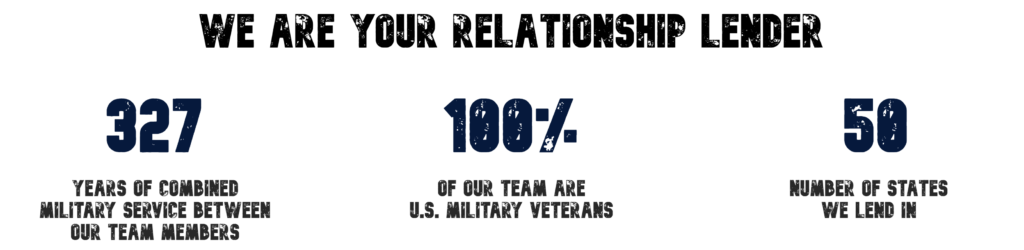
The Veteran Lending Team is a Residential Mortgage, Business & Commercial Lending, And Insurance team. Made up entirely of US Military Veterans, and Operating in All 50 states, The VLT has Relationship Lenders all over the country, standing by to help the American people with all their financial needs. Our motto is “We don’t sleep, ’till the mission’s complete”, so don’t hesitate to reach out to us on Social media, email us at ContactUs@VetLndr.com, or call us at 833-Vet-Lndr! We’re standing by, to stand by to help you achieve your goals
© 2023 The Veteran Lending Team. All Rights Reserved.
Programs, rates, terms and conditions are subject to change at any time without notice. All approvals are subject to underwriting guidelines.
Restrictions apply depending on program selected.
No official U.S. military or other government agency endorsement is implied.